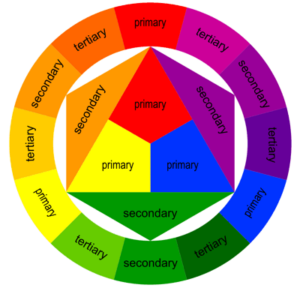
Colour wheel, a diagram used in the visual arts to represent the colours of the visible spectrum and their relationships to one another. The colours are arranged systematically into a circle, with each hue usually falling into one of three categories: primary, secondary, or intermediate. In fields such as painting, fashion, film, and design, artists use the colour wheel to assemble colour schemes and visualize how colours appear beside one another.
There are a number of colour wheels, each representing a different colour system. Colour systems are based on three primary colours from which all other colours in the system can be produced. The set of colours produced from the primary colours is known as the colour gamut. Although elementary-school students are typically taught that the primary colours are red, yellow, and blue, there is in fact no set standard of primary colours; any three colours can be assigned as primary colours to create a colour system. However, there are sets of primary colours that are more effective—that is, produce a more extensive colour gamut—than others. A couple of the best known are the subtractive colour system and the additive colour system.
The traditional painters’ colour wheel is one example of the subtractive colour system. Its primary colours are red, yellow, and blue (hence, it is also called the RYB colour model, after the first letter of each primary colour). The colours are called primary because they cannot be created by combining other hues. Any two of the three primary colours can be mixed to produce the secondary colours: green (made by combining yellow and blue), orange (yellow and red), and violet (blue and red). Mixing a primary colour with an adjacent secondary colour creates an intermediate colour. In this model, the intermediate colours are vermilion (red-orange), amber (yellow-orange), chartreuse (yellow-green), teal (blue-green), indigo (blue-violet), and magenta (red-violet).